dsh-thinking-effortDeepSeek Harness plugin
Configurable reasoning levels for hand-declared DSH llm-pi-ai models, with bilingual settings and subagent defaults.
- Stars
- 23
- Forks
- 0
- License
- MIT
- Last commit
- Sep 3, 2026
Overview
Configurable reasoning levels for hand-declared DSH llm-pi-ai models, with bilingual settings and subagent defaults.
Original README
Cached from the project repository on Sep 3, 2026. This is source content, separate from the Agents.md review above.
dsh-thinking-effort
A DSH (DeepSeek Harness) plugin that adds configurable reasoning effort levels to hand-declared llm-pi-ai models and sets a default reasoning effort for subagents.



- 中文 README
- 日本語 README
- 한국어 README
- Installation guide
- 中文安装指南
- 日本語インストールガイド
- 한국어 설치 안내
- Changelog
- 日本語 changelog
- 한국어 changelog
Compatibility boundaries: DSH Runtime compatibility covers the Settings transport only: modern DSH exposes
remote.settings, while legacy DSH exposesconnection.api.settings. The plugin detects the available runtime capability and keeps the legacy fallback optional, so the settings page does not require a Remote provider on older DSH builds.Gateway Protocol compatibility is a separate layer. It reads the official
llm-pi-ai.compatfieldssupportsDeveloperRoleandmaxTokensFieldwhen the DSH schema exposes them. DSH0.1.0-rc.7does not provide these fields; DSH0.1.0-rc.8and later supported ranges do. The optionaldsh-llm-openai-completionstransport can take over eligible custom OpenAI-compatible thinking providers when it is installed and enabled. For either gateway field,Autounsets the user override and restores the official protocol default.DSH
0.1.2-alpha.1and later accept language-pack locale IDs throughLocaleRuntime. This plugin registersjaandkodynamically, so no DSH core fork is required. Older DSH builds that only expose built-in locale IDs supportzhandenonly.The published runtime entries are
lib/index.js(Host) andlib/client.js(Client). After changing TypeScript or locale sources, runnpm run buildbefore running DSH or packing the plugin. Current DSH does not expose a public semver metadata contract, so runtime capability detection is authoritative. An optional version is used only when explicit metadata or test input supplies it; unknown valid versions still use the detected capabilities. The plugin supports both modernremote.settingsand legacyconnection.api.settings.
DSH compatibility
| DSH range | Gateway compatibility settings |
|---|---|
0.1.0-rc.7 | Not available |
0.1.0-rc.8 to <0.1.2-alpha.1 | Available |
0.1.2-alpha.1 to <0.1.3-0 | Available |
Why use it?
The llm-pi-ai adapter supports hand-declared third-party models, but those entries often do not declare reasoningEfforts. As a result, Composer does not show a reasoning effort selector, and gateway-specific values such as ultra cannot be mapped to DSH's standard levels.
This plugin provides the configuration layer needed to:
- Add default
off,high, andmaxoptions to models without a declaration; - Configure reasoning levels per model from the DSH settings page;
- Map a DSH level such as
highto a gateway value such asultra; - Set a default reasoning effort for subagents while preserving explicit request values;
- Keep existing user-defined model declarations unchanged.
The plugin is usually unnecessary when you only use built-in DSH models and their reasoning controls already work.
Identifiers
These identifiers have different responsibilities:
| Identifier | Purpose |
|---|---|
@hytime/dsh-thinking-effort | npm package, browser bundle path, loader ID, and host/client runtime ID |
thinking-effort | Cordis composition entry ID and settings Slot ID |
Features
| Feature | Description |
|---|---|
| Default levels | Adds off, high, and max without overwriting custom values |
| Per-model editor | Select levels and configure gateway values for both catalog/modelOverrides and models[] entries in Settings |
| Gateway compatibility | Configure supportsDeveloperRole and maxTokensField globally per provider or separately per model |
| Gateway mapping | Send ultra when the user selects DSH high |
| Subagent default | Apply a default effort only when a subagent request has no explicit value |
| Multilingual settings | Includes Chinese, English, Japanese, and Korean dictionaries; Japanese/Korean switching uses DSH language-pack support |
| Version watermark | Show the installed plugin version in the bottom-right corner |
Install, upgrade, and remove
Use the official DSH CLI to manage the plugin profile. A plain npm install does not register a DSH profile bundle.
bash1# Install the latest version
2dsh plugin --profile <profile> add @hytime/dsh-thinking-effort
3
4# Install a specific version
5dsh plugin --profile <profile> add @hytime/dsh-thinking-effort@0.1.14
6
7# Upgrade
8dsh plugin --profile <profile> update @hytime/dsh-thinking-effort
9
10# Remove
11dsh plugin --profile <profile> remove @hytime/dsh-thinking-effort
12rm -f "${DSH_HOME:-$HOME/.dsh}/thinking-effort-loaded.json"
See INSTALL.md for profile discovery, migration, validation, and troubleshooting.
Quick use
-
Open DSH Settings → Model capabilities and effort.
-
Use the Page language selector at the top to choose
中文,English,日本語, or한국어. DSH uses the persisted locale first, then the browser language, then English as the fallback. -
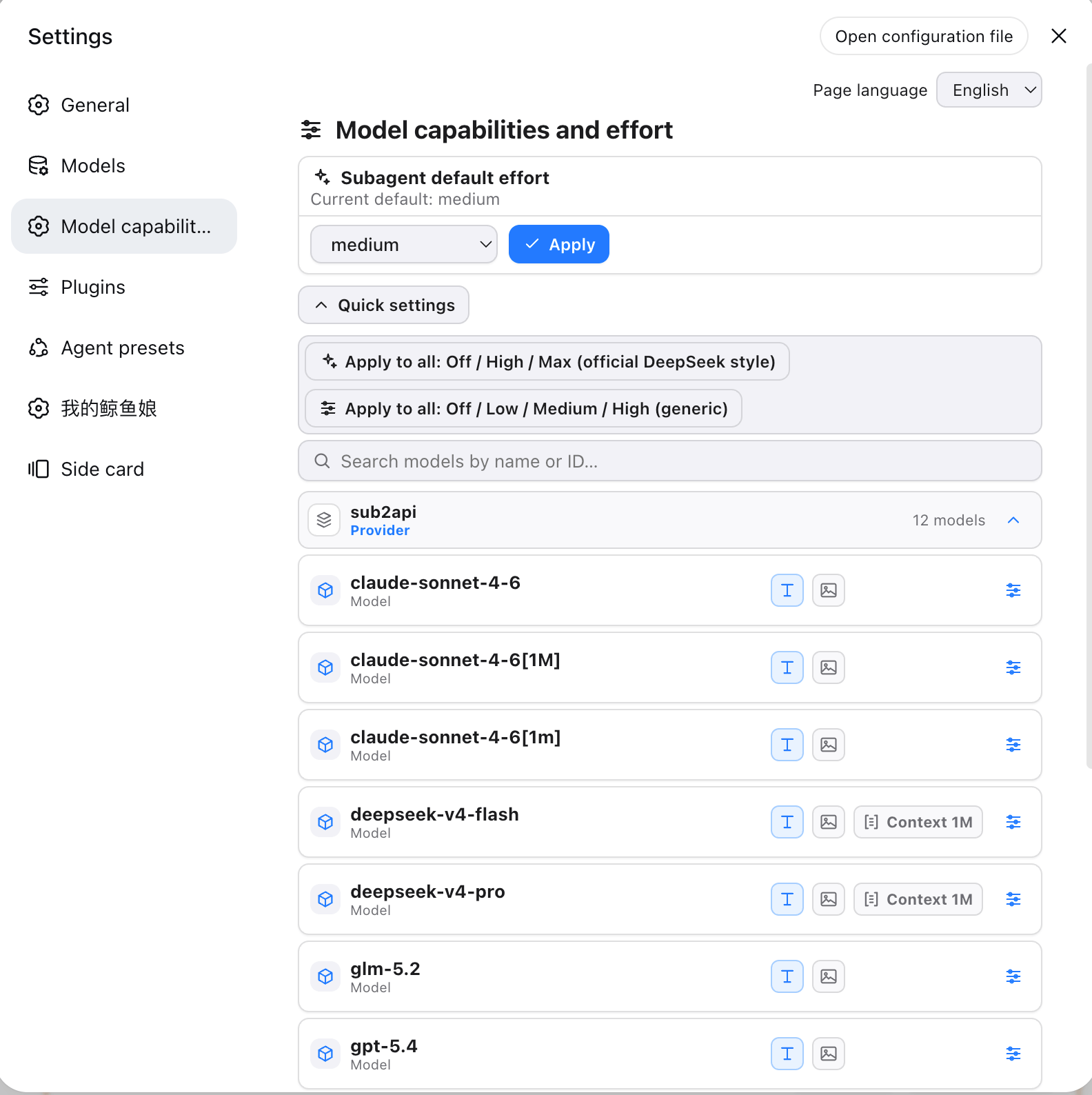
Choose a subagent default from the Subagent default effort card, then click Apply.
-
Use Quick settings to apply the official DeepSeek or generic preset to all models, or expand a provider and model for detailed configuration.
-
Use the search field to filter models by name or ID. Model rows show text/image input capability badges, a context-window badge when declared, and a settings button for per-model editing.
-
Select a reasoning level and enter the exact gateway value. For example:
DSH level Gateway value offLeave empty to omit the parameter highultramaxmax -
Return to Composer and select the model to use its reasoning selector.
The settings page shows the installed version as a small watermark such as v0.1.14 in the bottom-right corner.
Gateway compatibility configuration
The provider compat block is the global default for every model under that provider. Configure provider defaults with the official DSH YAML shape:
yamlproviders:
  qwen-gateway:
    compat:
      supportsDeveloperRole: false
      maxTokensField: max_tokens
    models:
      - id: qwen-plus
      - id: qwen-thinking
        compat:
          maxTokensField: max_completion_tokens
A model-level compat overrides the provider default field-by-field. Fields not written at the model layer continue to inherit from the provider. Auto deletes the current-layer field and restores provider inheritance. For a given route/provider, any non-empty models[] together with any non-empty modelOverrides is invalid; the official schema rejects this invalid configuration, and the plugin fails closed for malformed data.
The provider area in Settings edits defaults for all models. Both catalog models and custom YAML models[] entries expose a single-model compat editor: catalog models write modelOverrides.<model>.compat, while models[] models write models[].compat. Because the Settings API does not support array-index path operations, a models[] edit writes one complete providers.<route>.models array set while preserving other models, unknown fields, and compat fields.
These compat values are control plane configuration. They do not implement or replace the gateway transport; an external transport remains responsible for network requests.
Settings page layout
The page header contains the language selector. Below it, the Subagent default effort card controls the default for requests without an explicit effort. The Quick settings controls apply a preset across models. Provider sections can be expanded or collapsed; each model row exposes input capabilities, context length, and gateway compatibility controls in its settings area. models[] saves use one complete array set rather than an array-index path operation.
How it works
- Host: Scans
llm-pi-aimodelsandmodelOverrideson startup and settings changes, adding defaults only wherereasoningEffortsis missing. - Client: Registers a settings page through the DSH Settings Remote (
ctx.remote.settings) and the official DSH locale service. Chinese, English, Japanese, and Korean dictionaries are maintained separately insrc/locales/zh.json,src/locales/en.json,src/locales/ja.json, andsrc/locales/ko.json, then generated into the client bundle before publishing. - Subagents: Stores the default in the
llm-pi-aiuser layer assubagentEffort. Theagent/requestwaterfall only fills requests that do not already specify an effort. - No configured default: The plugin does not automatically choose
off,high, ormax; the request omitsreasoningand the gateway decides its own default behavior.
Limitations
llm-pi-aiexposes seven standard levels:off,minimal,low,medium,high,xhigh, andmax.- Non-
offlevels require a gateway value. An emptyoffvalue means that the parameter is omitted. - The selected subagent level must be supported by the target model, or the gateway may return
UNSUPPORTED_REASONING_EFFORT. offand an unset effort may both omitreasoning; whether this disables thinking depends on the gateway protocol.- Host changes require a DSH restart. Settings and locale changes are applied in the browser, with a refresh available when needed.
CI and release maintenance
- Pull requests and pushes to
mainrun the quality matrix on Node22.19.0and24.x. - The workflow uses
npm ci; maintainers must commitpackage-lock.jsonwhen dependencies change. - The ordinary CI workflow does not publish to npm. Publishing is triggered only by a
v<version>tag throughpublish.yml. - Before creating a release tag, update
package.jsonversion andCHANGELOG.mdfiles, commit those changes, and create the matchingv<version>tag. The tag must point to a commit in themainhistory. - npm Trusted Publishing must be configured for repository
hytime/dsh-thinking-effortand workflowpublish.yml. The workflow publishes provenance through GitHub OIDC and does not requireNPM_TOKEN. - Before publishing, the workflow builds and tests three official DSH capability representatives in this order:
dsh-v0.1.0-rc.7(0.1.0-rc.7),dsh-v0.1.1-rc.2(0.1.1-rc.2), anddsh-v0.1.2-alpha.3(0.1.2-alpha.3), using the officialdsh plugincommand and real compatibility checks. - The workflow never changes the package version or any
CHANGELOGfile automatically; an existing npm version also blocks publishing.