Vibe-SkillsDeepSeek Harness plugin
Intelligent Skill routing and workflow orchestration for AI agents — +21.12 pp reward, −29.6% tokens on SkillsBench with DeepSeekV4Flash-VE.
- Stars
- 3.1K
- Forks
- 260
- License
- Apache-2.0
- Last commit
- Aug 31, 2026
- Latest release
- v4.1.0
Overview
Intelligent Skill routing and workflow orchestration for AI agents — +21.12 pp reward, −29.6% tokens on SkillsBench with DeepSeekV4Flash-VE.
Original README
Cached from the project repository on Sep 2, 2026. This is source content, separate from the Agents.md review above.


Measured on SkillsBench
Mean verifier reward: +21.12 pp
Total tokens: -29.6% · Tool calls: -33.1%
SkillsBench is a benchmark designed to evaluate whether AI agents can effectively use Skills to complete professional tasks across diverse domains. Its purpose is to measure how much a model’s ability to solve complex real-world tasks improves when it is equipped with specialized Skills.
To evaluate performance in production-like environments where a large number of Skills are installed simultaneously, we adapted SkillsBench into a more realistic large-scale multi-Skill setting. In the original SkillsBench setup, each task is provided only with the specialized Skill associated with that task. In our modified setting, every task is evaluated in a global environment containing all 195 specialized Skills, while all other experimental conditions remain unchanged. This setting is intended to assess whether an agent can autonomously discover, select, and orchestrate the relevant Skills from a large installed Skill pool, and organize them into an effective workflow for completing complex tasks.
vibeskills v4.1.0 was benchmarked on SkillsBench (https://www.skillsbench.ai/) using DeepSeekV4Flash-VE and OpenHands as the baseline evaluation setup. Compared with the baseline without vibeskills, vibeskills increased the average task score by 21.12%, while reducing token consumption by 29.6% and tool calls by 33.1%.
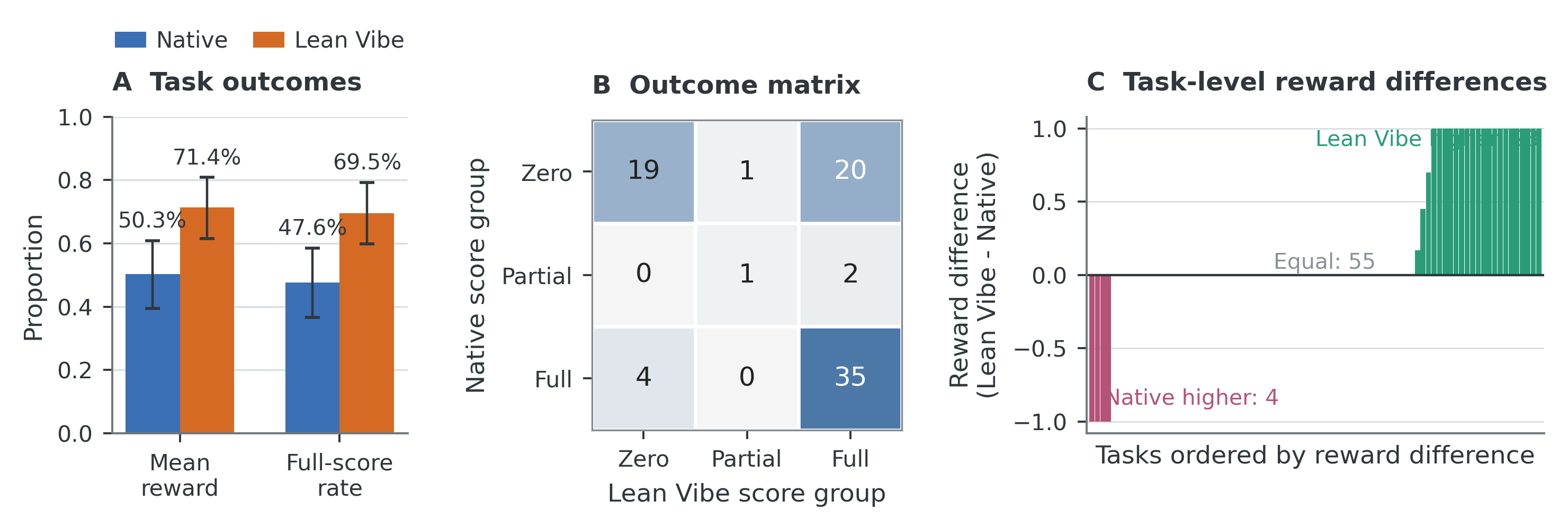
Task quality: 39 to 57 full-score tasks; Lean Vibe scored higher on 23 tasks, Native on 4, with 55 ties.
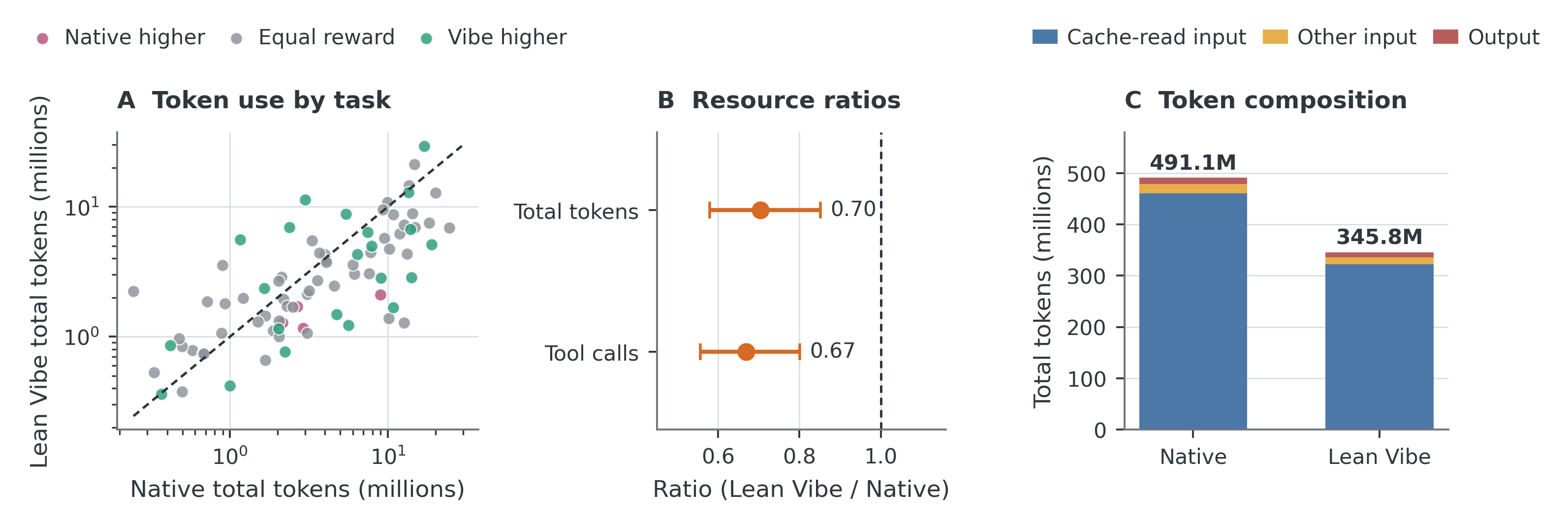
Resource use: 491.122M to 345.756M total tokens, with tool calls reduced from 9,954 to 6,664.
Analysis of the logs from the original benchmark shows that VibeSkills achieves better task performance not by invoking more Skills.
Instead, it first clarifies the task objective and delivery requirements, then decomposes a complex task into several verifiable subtasks. It subsequently selects only a small number of truly relevant capabilities from a large pool of candidate Skills and executes them in an order determined by their dependencies. This helps reduce misunderstandings of the task, omitted steps, and incorrect Skill selection, thereby improving overall task performance.
In terms of token cost and tool usage, this workflow also eliminates a substantial amount of ineffective trial and error. Native agents are more likely to repeatedly invoke tools in unproductive directions, reread the same context, and redo previous work. In contrast, VibeSkills converges more quickly on the critical steps through clearer planning and pre-delivery checks. As a result, it not only improves task quality, but also significantly reduces tool-call loops and the token overhead caused by repeated context processing.
Study, public data, and reproduction ·



Task
Use public data to complete a reproducible classification experiment and deliver a data audit, statistical review, 4 result figures, a scientific report, and a 7-slide group-meeting deck.
The diagram shows what happened after the requirement and plan were approved: how the task was executed, what it produced, and how the result was checked.
The task used the L workflow and proceeded in order. During publication
preparation, the configured folders on the same host contained more than 100
Skills. VibeSkills reviewed the candidates and their SKILL.md files, selected
7 for this task, and arranged the work into 5 groups and 10 work units. Those
units covered environment setup, data audit, modeling, statistical review,
figures, the report, and the slide deck.
After the work finished, VibeSkills ran 17 checks across the data, experiment results, figures, report, and slides. The task passed final acceptance after the required files, cross-deliverable consistency, and core reproduction all passed.
7 Skills selected · 5 work groups · 10 / 10 work units completed · 17 / 17 checks passed
mermaid1%%{init: {"flowchart": {"curve": "monotoneX", "nodeSpacing": 18, "rankSpacing": 36}}}%%
2flowchart LR
3    subgraph DISC["Skill discovery"]
4        direction TB
5        A["Configured Skill folders<br/>100+ Skills"]
6        B["Shortlist candidates<br/>Read SKILL.md"]
7        SEL["Skill selection<br/>7 Skills assigned"]
8        A --> B
9        B --> SEL
10    end
11
12    subgraph EXEC["Execution · 5 work groups · 10 work units"]
13        direction TB
14
15        subgraph G1["G1 · 01 Environment and data"]
16            direction LR
17            u01["U01<br/>Environment setup"]
18            u02["U02<br/>Data audit"]
19            u01 --> u02
20        end
21
22        subgraph G2["G2 · 02 Modeling and reproduction"]
23            direction LR
24            u03["U03<br/>Baseline experiment"]
25        end
26
27        subgraph G3["G3 · 03 Statistics and scientific review"]
28            direction LR
29            u04["U04<br/>Statistical analysis"]
30            u05["U05<br/>Scientific review"]
31            u04 --> u05
32        end
33
34        subgraph G4["G4 · 04 Figures and report"]
35            direction LR
36            u06["U06<br/>Result figures"]
37            u07["U07<br/>Report draft"]
38            u08["U08<br/>Report review"]
39            u06 --> u07
40            u07 --> u08
41        end
42
43        subgraph G5["G5 · 05 Slides and acceptance"]
44            direction LR
45            u09["U09<br/>Group-meeting slides"]
46            u10["U10<br/>Case package and consistency"]
47            u09 --> u10
48        end
49
50        G1 --> G2
51        G2 --> G3
52        G3 --> G4
53        G4 --> G5
54    end
55
56    subgraph MID["Run and outputs"]
57        direction TB
58        S(["Run status<br/>10 / 10 completed<br/>0 failed · 0 blocked"])
59        D["Real outputs<br/>4 figures · Scientific report<br/>7-slide deck"]
60        S --> D
61    end
62
63    subgraph VERIFY["Verification · 17 checks"]
64        direction TB
65
66        subgraph V1["V1 · Foundation and plan"]
67            direction LR
68            t01["T01<br/>required-files"]
69            t02["T02 module-output-<br/>patterns"]
70            t03["T03 runtime-plan-<br/>binding"]
71            t04["T04 environment-<br/>contract"]
72            t01 --> t02
73            t02 --> t03
74            t03 --> t04
75        end
76
77        subgraph V2["V2 · Data, model, and reproduction"]
78            direction LR
79            t05["T05<br/>dataset-contract"]
80            t06["T06 split-and-model-<br/>contract"]
81            t07["T07<br/>baseline-results"]
82            t08["T08 exact-<br/>reproduction"]
83            t05 --> t06
84            t06 --> t07
85            t07 --> t08
86        end
87
88        subgraph V3["V3 · Statistics and deliverables"]
89            direction LR
90            t09["T09 uncertainty-<br/>consistency"]
91            t10["T10 statistics-write-<br/>protection"]
92            t11["T11 figure-<br/>traceability"]
93            t12["T12 report-<br/>consistency"]
94            t13["T13 slides-<br/>consistency"]
95            t09 --> t10
96            t10 --> t11
97            t11 --> t12
98            t12 --> t13
99        end
100
101        subgraph V4["V4 · Publication and boundaries"]
102            direction LR
103            t14["T14 bilingual-summary-<br/>consistency"]
104            t15["T15 visual-material-<br/>guidance"]
105            t16["T16 manifest-<br/>boundary"]
106            t17["T17 artifact-path-<br/>boundary"]
107            t14 --> t15
108            t15 --> t16
109            t16 --> t17
110        end
111
112        V1 --> V2
113        V2 --> V3
114        V3 --> V4
115    end
116
117    E(["Final acceptance<br/>17 / 17 checks passed<br/>PASS"])
118
119    DISC --> EXEC
120    EXEC --> MID
121    MID --> VERIFY
122    VERIFY --> E
123
124    classDef source fill:#EAF3F3,stroke:#2B6F73,color:#182026;
125    classDef selected fill:#F5EBEE,stroke:#8A5363,color:#182026;
126    classDef unit fill:#FFFFFF,stroke:#5B7F83,color:#182026;
127    classDef status fill:#F7EEF1,stroke:#8A5363,color:#182026,stroke-width:2px;
128    classDef output fill:#E8F2F0,stroke:#2D7F75,color:#182026;
129    classDef check fill:#FFFFFF,stroke:#8A9AA7,color:#182026;
130    classDef result fill:#EAF4EE,stroke:#2F7A4B,color:#182026,stroke-width:2px;
131    class A,B source;
132    class SEL selected;
133    class u01,u02,u03,u04,u05,u06,u07,u08,u09,u10 unit;
134    class S status;
135    class D output;
136    class t01,t02,t03,t04,t05,t06,t07,t08,t09,t10,t11,t12,t13,t14,t15,t16,t17 check;
137    class E result;
138
139    style DISC fill:transparent,stroke:#AAB7C4,stroke-width:1px,stroke-dasharray:4 3;
140    style EXEC fill:transparent,stroke:#AAB7C4,stroke-width:1px,stroke-dasharray:4 3;
141    style MID fill:transparent,stroke:#AAB7C4,stroke-width:1px,stroke-dasharray:4 3;
142    style VERIFY fill:transparent,stroke:#AAB7C4,stroke-width:1px,stroke-dasharray:4 3;
143    style G1 fill:#FFFFFF,stroke:#DCE4EA,stroke-width:1px;
144    style G2 fill:#FFFFFF,stroke:#DCE4EA,stroke-width:1px;
145    style G3 fill:#FFFFFF,stroke:#DCE4EA,stroke-width:1px;
146    style G4 fill:#FFFFFF,stroke:#DCE4EA,stroke-width:1px;
147    style G5 fill:#FFFFFF,stroke:#DCE4EA,stroke-width:1px;
148    style V1 fill:#FFFFFF,stroke:#DCE4EA,stroke-width:1px;
149    style V2 fill:#FFFFFF,stroke:#DCE4EA,stroke-width:1px;
150    style V3 fill:#FFFFFF,stroke:#DCE4EA,stroke-width:1px;
151    style V4 fill:#FFFFFF,stroke:#DCE4EA,stroke-width:1px;
152    linkStyle default stroke:#6D878B,stroke-width:1px;
View case execution · View final delivery


VibeSkills gives an Agent one process from receiving a task to checking the delivery.
Each stage answers a concrete question: what needs to be done, how the work should proceed, which Skills should take part, what actually happened, and whether the result is ready to deliver.
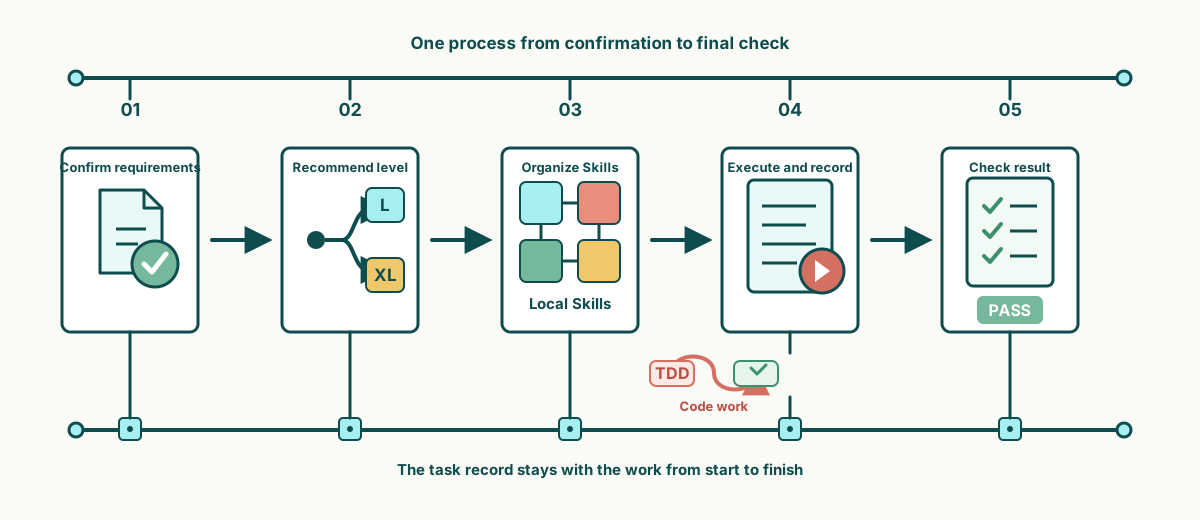
- Confirms the requirement. Before work begins, it confirms the goal, constraints, available material, and expected delivery. The process stops here until the requirement is approved, giving the plan and final check a clear basis.
- Recommends a level. VibeSkills recommends
LorXLfrom the task's scope, steps, dependencies, and opportunities for parallel work. You then confirm the level. Manageable work proceeds in order; larger work is split more finely. - Organizes Skills. VibeSkills reviews the local Skill folders, selects the methods that fit each part, and states what each Skill owns, what it should deliver, and how completion will be checked.
- Executes and records. After plan approval, the current Agent completes the work. Code tasks can use test-driven development (TDD) when appropriate: show the problem with a failing test, make the change, and run the tests again. Completed, failed, and blocked states are recorded so a later session can continue.
- Checks the result. VibeSkills compares the actual result with every planned item. Required work that is incomplete, failed, or blocked prevents final acceptance.
When to use L or XL
| Level | Best for | How it works |
|---|---|---|
L | Multi-step work of manageable size | Splits the task, then works through the parts in order with less time and context overhead |
XL | Larger work with several relatively independent parts | Uses a more detailed breakdown and can run up to two non-conflicting parts at the same time, with additional coordination and result collection |


Local Skills can store tool usage, working steps, decision rules, and checking methods.
VibeSkills reviews the local Skill folders you configure, then shortlists the Skills that fit the work required by each part of the task.
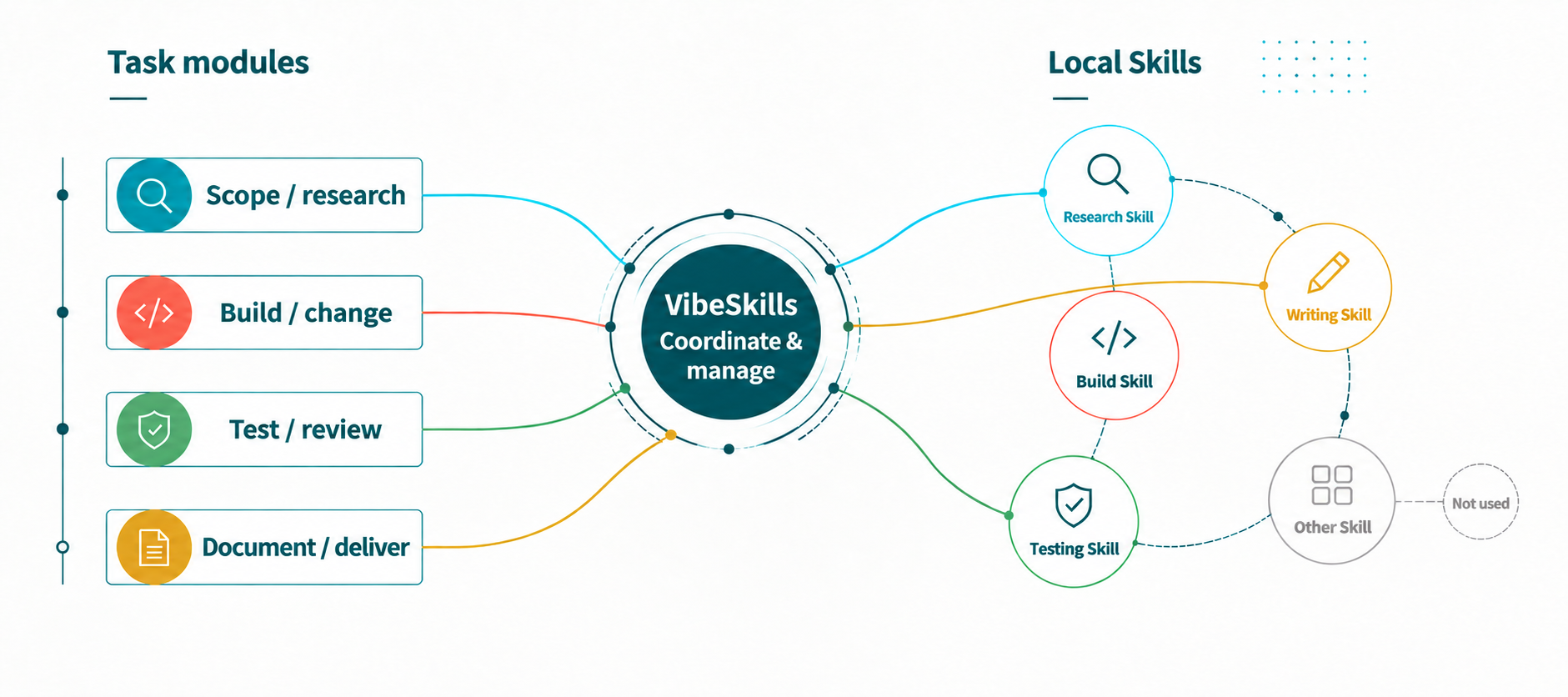
The left side shows the different kinds of work in the task, VibeSkills makes the assignment in the middle, and the local Skill folders are on the right. A selected Skill is tied to concrete work, expected delivery, and a check. The current Agent then follows the shared plan.
| Passive Skill triggering | With VibeSkills |
|---|---|
| The AI reacts to a few obvious words | It splits the whole task first |
| The same familiar Skills are used repeatedly | Each part is checked for a better-fitting Skill |
| Unmatched work is handled on the spot | A useful Skill is assigned to specific work with a stated result |
| Separate calls are left disconnected | All results are brought together and checked at the end |
VibeSkills does something straightforward: it first makes the whole task clear, then assigns the right Skills to the relevant parts. It coordinates the work and checks the combined result at the end. The task uses the Skills it needs; the rest of the local library stays available without entering the plan.
You can keep adding your own Skills, team Skills, and third-party Skills. VibeSkills does not call every installed Skill automatically; it selects the Skills that fit the current task. The size of the library defines the available choices, not a list that every task must use.
Will a large Skill library use a lot of tokens?
VibeSkills checks the Skill folders you configure, but finding files locally and placing their full contents in the model context are different operations.
Discovery and index generation happen locally. VibeSkills first extracts compact information such as each Skill's name, description, intended use, and boundaries, then uses that information to shortlist candidates for each part of the task.
Only retained candidates are then read as complete SKILL.md files. Execution
uses only the Skills written into the plan. Token usage therefore depends mainly
on how many candidates the task retains, how long those documents are, and how
complex the task is. It is not the same as reading the full local Skill library
into the model context.
This overhead is not zero. More candidates, longer Skill documents, or a more finely divided task will use more context. The current design bounds that cost with a local index, candidate shortlisting, and on-demand reading.
Local folders and selection records
Alongside the shared Skills directory, more local folders can be listed in
~/.vibeskills/skill-roots.json or
<workspace>/.vibeskills/skill-roots.json.
A Skill needs a readable SKILL.md, a name that does not conflict with another
Skill, and a clear fit for the current work before it can be selected. Adding a
local folder makes those Skills available to later tasks without waiting for the
VibeSkills repository to include them.
During planning, agent_skill_organization stores which Skills are intended for
each part of the task. During execution, module_assignments stores the actual
assignment. Finding a Skill means it can be considered; it does not mean the
Skill has already taken part in the work.


A public example lets readers follow the requirement, plan, actual result, and final check.
VibeSkills keeps the approved requirement, plan, execution progress, and final check in the same task record. A later session can continue from the saved progress, and a review can compare the original plan with the actual result. Installation state is recorded separately so it is not confused with task completion.
View the record files
| File or directory | What it is for |
|---|---|
install-receipt.json | Records the files written by the installer so check can find missing or changed files |
session_root | Stores the input, progress, important decisions, and summary for one task |
module-work-plan.json | Stores the approved work plan, including responsibility, expected output, and checks |
module-execution.json | Stores what each part actually produced and whether it completed, failed, or was blocked |
delivery-acceptance-report.json or .md | Stores the final check and shows which items passed |
Maintainers can use the pre-release checks. Start with the checks in that list and run wider audits only when there is a reason.
A successful installation does not mean the task ran, and a task record does not mean the final result passed its checks.


- Invoke. In any AI application that supports local Skills, invoke VibeSkills through the application's Skills entry, using
$vibe,/vibe, or the syntax it provides. - Discover. VibeSkills scans the Skills installation directory and any additional local Skill folders you configure to find the Skills currently available.
- Organize. It selects suitable Skills for the task, assigns them to the relevant work, and coordinates the result. You do not need to remember which Skill should be used when.

More Documentation
| Need | Start here |
|---|---|
| See a complete real run | Machine-learning experiment case |
| Install, update, uninstall | Simple install |
| First use | Quick start |
| Current release | GitHub release metadata |
| How it works | Documentation index |
| Troubleshooting | Troubleshooting guide |
| Contributing | Contribution guide |
Community and Credits
Questions, corrections, and well-scoped contributions are welcome through GitHub Issues and pull requests.
VibeSkills discussions and community practice can also continue on LINUX DO. It is a place to exchange technical questions, AI practice, and experience. Thank you to the LINUX DO community for supporting this project.
The VibeSkills 3.1.0 community practice cases collect several examples that were shared with the community.
Community contributors include xiaozhongyaonvli and ruirui2345.
Third-party software attribution and license information are listed in NOTICE and third-party licenses.